
Privacy Policy
Table of contents
- Privacy Policy Introduction and Overview
- Scope
- Legal bases
- Contact details of the data protection controller
- Contact details of our data protection officer
- Storage Period
- Rights in accordance with the General Data Protection Regulation
- Security of data processing operations
- Communications
- Data Processing Agreement (DPA)
- Cookies
- Application Data
- Customer Data
- Web hosting
- Web Analytics
- Online Map Services Introduction
- Online Booking Systems Introduction
- Explanation of the terminology used
- Closing Remarks
Privacy Policy Introduction and Overview
We have written this privacy policy (version 09.02.2026-112786303) in order to explain to you, in accordance with the provisions of the General Data Protection Regulation (EU) 2016/679 and applicable national laws, which personal data (data for short) we as the controller – and the processors commissioned by us (e.g. providers) – process, will process in the future and what legal options you have. The terms used are to be considered gender-neutral.
In short: We provide you with comprehensive information about any of your personal data we process.
Privacy policies usually sound very technical and use legal terminology. However, this privacy policy is intended to describe the most important things to you as simply and transparently as possible. So long as it aids transparency, technical terms are explained in a reader-friendly manner, links to further information are provided and graphics are used. We are thus informing in clear and simple language that we only process personal data in the context of our business activities if there is a legal basis for it. This is certainly not possible with brief, unclear and legal-technical statements, as is often standard on the internet when it comes to data protection. I hope you find the following explanations interesting and informative. Maybe you will also find some information that you have not been familiar with.
If you still have questions, we kindly ask you to contact the responsible body named below or in the imprint, follow the existing links and look at further information on third-party sites. You can of course also find our contact details in the imprint.
Scope
This privacy policy applies to all personal data processed by our company and to all personal data processed by companies commissioned by us (processors). With the term personal data, we refer to information within the meaning of Article 4 No. 1 GDPR, such as the name, email address and postal address of a person. The processing of personal data ensures that we can offer and invoice our services and products, be it online or offline. The scope of this privacy policy includes:
- all online presences (websites, online shops) that we operate
- Social media presences and email communication
- mobile apps for smartphones and other devices
In short: This privacy policy applies to all areas in which personal data is processed in a structured manner by the company via the channels mentioned. Should we enter into legal relations with you outside of these channels, we will inform you separately if necessary.
Legal bases
In the following privacy policy, we provide you with transparent information on the legal principles and regulations, i.e. the legal bases of the General Data Protection Regulation, which enable us to process personal data.
Whenever EU law is concerned, we refer to REGULATION (EU) 2016/679 OF THE EUROPEAN PARLIAMENT AND OF THE COUNCIL of April 27, 2016. You can of course access the General Data Protection Regulation of the EU online at EUR-Lex, the gateway to EU law, at https://eur-lex.europa.eu/legal-content/EN/TXT/?uri=celex%3A32016R0679.
We only process your data if at least one of the following conditions applies:
- Consent (Article 6 Paragraph 1 lit. a GDPR): You have given us your consent to process data for a specific purpose. An example would be the storage of data you entered into a contact form.
- Contract (Article 6 Paragraph 1 lit. b GDPR): We process your data in order to fulfill a contract or pre-contractual obligations with you. For example, if we conclude a sales contract with you, we need personal information in advance.
- Legal obligation (Article 6 Paragraph 1 lit. c GDPR): If we are subject to a legal obligation, we will process your data. For example, we are legally required to keep invoices for our bookkeeping. These usually contain personal data.
- Legitimate interests (Article 6 Paragraph 1 lit. f GDPR): In the case of legitimate interests that do not restrict your basic rights, we reserve the right to process personal data. For example, we have to process certain data in order to be able to operate our website securely and economically. Therefore, the processing is a legitimate interest.
Other conditions such as making recordings in the interest of the public, the exercise of official authority as well as the protection of vital interests do not usually occur with us. Should such a legal basis be relevant, it will be disclosed in the appropriate place.
In addition to the EU regulation, national laws also apply:
- In Austria this is the Austrian Data Protection Act (Datenschutzgesetz), in short DSG.
- In Germany this is the Federal Data Protection Act (Bundesdatenschutzgesetz), in short BDSG.
Should other regional or national laws apply, we will inform you about them in the following sections.
Contact details of the data protection controller
If you have any questions about data protection or the processing of personal data, you will find below the contact details of the controller in accordance with Article 4(7) of the EU General Data Protection Regulation (GDPR):
slashsec Red Teaming GmbH
Kärtner Ring 5-7, A-1010 Wien
Authorised to represent: Dipl.-Ing. David Wind, BSc
E-Mail: datenschutz@slashsec.at
Phone: +43 681/1037 6994
Company details: https://www.slashsec.at/de/legal/impressum
Contact details of our data protection officer
You can find the contact details of our data protection officer below:
E-Mail: datenschutz@slashsec.at
Phone: +43 681/10 37 69 94
Storage Period
It is a general criterion for us to store personal data only for as long as is absolutely necessary for the provision of our services and products. This means that we delete personal data as soon as any reason for the data processing no longer exists. In some cases, we are legally obliged to keep certain data stored even after the original purpose no longer exists, such as for accounting purposes.
If you want your data to be deleted or if you want to revoke your consent to data processing, the data will be deleted as soon as possible, provided there is no obligation to continue its storage.
We will inform you below about the specific duration of the respective data processing, provided we have further information.
Rights in accordance with the General Data Protection Regulation
In accordance with Articles 13, 14 of the GDPR, we inform you about the following rights you have to ensure fair and transparent processing of data:
- According to Article 15 DSGVO, you have the right to information about whether we are processing data about you. If this is the case, you have the right to receive a copy of the data and to know the following information:
- for what purpose we are processing;
- the categories, i.e. the types of data that are processed;
- who receives this data and if the data is transferred to third countries, how security can be guaranteed;
- how long the data will be stored;
- the existence of the right to rectification, erasure or restriction of processing and the right to object to processing;
- that you can lodge a complaint with a supervisory authority (links to these authorities can be found below);
- the origin of the data if we have not collected it from you;
- Whether profiling is carried out, i.e. whether data is automatically evaluated to arrive at a personal profile of you.
- You have a right to rectification of data according to Article 16 GDPR, which means that we must correct data if you find errors.
- You have the right to erasure (“right to be forgotten”) according to Article 17 GDPR, which specifically means that you may request the deletion of your data.
- According to Article 18 of the GDPR, you have the right to restriction of processing, which means that we may only store the data but not use it further.
- According to Article 20 of the GDPR, you have the right to data portability, which means that we will provide you with your data in a standard format upon request.
- According to Article 21 DSGVO, you have the right to object, which entails a change in processing after enforcement.
- If the processing of your data is based on Article 6(1)(e) (public interest, exercise of official authority) or Article 6(1)(f) (legitimate interest), you may object to the processing. We will then check as soon as possible whether we can legally comply with this objection.
- If data is used to conduct direct advertising, you may object to this type of data processing at any time. We may then no longer use your data for direct marketing.
- If data is used to conduct profiling, you may object to this type of data processing at any time. We may no longer use your data for profiling thereafter.
- According to Article 22 of the GDPR, you may have the right not to be subject to a decision based solely on automated processing (for example, profiling).
- You have the right to lodge a complaint under Article 77 of the GDPR. This means that you can complain to the data protection authority at any time if you believe that the data processing of personal data violates the GDPR.
In short: you have rights – do not hesitate to contact the responsible party listed above with us!
If you believe that the processing of your data violates data protection law or your data protection rights have been violated in any other way, you can complain to the supervisory authority. For Austria, this is the data protection authority, whose website can be found at https://www.dsb.gv.at/. In Germany, there is a data protection officer for each federal state. For more information, you can contact the Federal Commissioner for Data Protection and Freedom of Information (BfDI). The following local data protection authority is responsible for our company:
Austria Data protection authority
Manager:Dr. Matthias Schmidl
Address: Barichgasse 40-42, 1030 Wien
Phone number.: +43 1 52 152-0
E-mail address: dsb@dsb.gv.at
Website: https://www.dsb.gv.at/
Security of data processing operations
In order to protect personal data, we have implemented both technical and organisational measures. We encrypt or pseudonymise personal data wherever this is possible. Thus, we make it as difficult as we can for third parties to extract personal information from our data.
Article 25 of the GDPR refers to “data protection by technical design and by data protection-friendly default” which means that both software (e.g. forms) and hardware (e.g. access to server rooms) appropriate safeguards and security measures shall always be placed. If applicable, we will outline the specific measures below.
TLS encryption with https
The terms TLS, encryption and https sound very technical, which they are indeed. We use HTTPS (Hypertext Transfer Protocol Secure) to securely transfer data on the Internet.
This means that the entire transmission of all data from your browser to our web server is secured – nobody can “listen in”.
We have thus introduced an additional layer of security and meet privacy requirements through technology design Article 25 Section 1 GDPR). With the use of TLS (Transport Layer Security), which is an encryption protocol for safe data transfer on the internet, we can ensure the protection of confidential information.
You can recognise the use of this safeguarding tool by the little lock-symbol  , which is situated in your browser’s top left corner in the left of the internet address (e.g. examplepage.uk), as well as by the display of the letters https (instead of http) as a part of our web address.
If you want to know more about encryption, we recommend you to do a Google search for “Hypertext Transfer Protocol Secure wiki” to find good links to further information.
Communications
| Communications Overview 👥 Affected parties: Anyone who communicates with us via phone, email or online form 🤝 Processed data: e. g. telephone number, name, email address or data entered in forms. You can find more details on this under the respective form of contact 📓 Purpose: handling communication with customers, business partners, etc. 📅 Storage duration: for the duration of the business case and the legal requirements ⚖️ Legal basis: Article 6 (1) (a) GDPR (consent), Article 6 (1) (b) GDPR (contract), Article 6 (1) (f) GDPR (legitimate interests) |
If you contact us and communicate with us via phone, email or online form, your personal data may be processed.
The data will be processed for handling and processing your request and for the related business transaction. The data is stored for this period of time or for as long as is legally required.
Affected persons
The above-mentioned processes affect all those who seek contact with us via the communication channels we provide.
Telephone
When you call us, the call data is stored in a pseudonymised form on the respective terminal device, as well as by the telecommunications provider that is being used. In addition, data such as your name and telephone number may be sent via email and stored for answering your inquiries. The data will be erased as soon as the business case has ended and the legal requirements allow for its erasure.
If you communicate with us via email, your data is stored on the respective terminal device (computer, laptop, smartphone, …) as well as on the email server. The data will be deleted as soon as the business case has ended and the legal requirements allow for its erasure.
Online forms
If you communicate with us using an online form, your data is stored on our web server and, if necessary, forwarded to our email address. The data will be erased as soon as the business case has ended and the legal requirements allow for its erasure.
Legal bases
Data processing is based on the following legal bases:
- Art. 6 para. 1 lit. a GDPR (consent): You give us your consent to store your data and to continue to use it for the purposes of the business case;
- Art. 6 para. 1 lit. b GDPR (contract): For the performance of a contract with you or a processor such as a telephone provider, or if we have to process the data for pre-contractual activities, such as preparing an offer;
- Art. 6 para. 1 lit. f GDPR (legitimate interests): We want to conduct our customer inquiries and business communication in a professional manner. Thus, certain technical facilities such email programs, Exchange servers and mobile network operators are necessary to efficiently operate our communications.
Data Processing Agreement (DPA)
In this section, we would like to explain what a Data Processing Agreement is and why it is needed. As the term “Data Processing Agreement” is quite lengthy, we will often only use the acronym DPA here in this text. Like most companies, we do not work alone, but also use the services of other companies or individuals. By involving different companies or service providers, we may pass on personal data for processing. These partners then act as processors with whom we conclude a contract, the so-called Data Processing Agreement (DPA). Most importantly for you to know is that any processing of your personal data takes place exclusively according to our instructions and must be regulated by the DPA.
Who are the processors?
As a company and website owner, we are responsible for any of your data that is processed by us. In addition to the controller, there may also be so-called processors involved. This includes any company or person who processes your personal data. More precisely and according to the GDPR’s definition, this means: Any natural or legal person, authority, institution or other entity that processes your personal data is considered a processor. Processors can therefore be service providers such as hosting or cloud providers, payment or newsletter providers or large companies such as Google or Microsoft.
To make the terminology easier to comprehend, here is an overview of the GDPR’s three roles:
Data subject (you as a customer or interested party) → Controller (we as a company and contracting entity) → Processors (service providers such as web hosts or cloud providers)
Contents of a Data Processing Agreement
As mentioned above, we have concluded a DPA with our partners who act as processors. First and foremost, it states that the processor processes the data exclusively in accordance with the GDPR. The contract must be concluded in writing, although an electronic contract completion is also considered a “written contract”. Any processing of personal data only takes place after this contract is concluded. The contract must contain the following:
- indication to us as the controller
- obligations and rights of the controller
- categories of data subjects
- type of personal data
- type and purpose of data processing
- subject and duration of data processing
- location of data processing
Furthermore, the contract contains all obligations of the processor. The most important obligations are:
- ensuring data security measures
- taking possible technical and organisational measures to protect the rights of the data subject
- maintaining a data processing record
- cooperation with the data protection authority upon request
- performing a risk analysis for any received personal data
- subprocessors may only be appointed with the written consent of the controller
You can see an example of what a DPA looks like at https://gdpr.eu/data-processing-agreement/. This link shows a sample contract.
Cookies
| Cookies Overview 👥 Affected parties: visitors to the website 🤝 Purpose: depending on the respective cookie. You can find out more details below or from the software manufacturer that sets the cookie. 📓 Processed data: depends on the cookie used. More details can be found below or from the manufacturer of the software that sets the cookie. 📅 Storage duration: can vary from hours to years, depending on the respective cookie ⚖️ Legal basis: Art. 6 para. 1 lit. a GDPR (consent), Art. 6 para. 1 lit. f GDPR (legitimate interests) |
What are cookies?
Our website uses HTTP-cookies to store user-specific data.
In the following we explain what cookies are and why they are used, so that you can better understand the following privacy policy.
Whenever you surf the Internet, you are using a browser. Common browsers are for example, Chrome, Safari, Firefox, Internet Explorer and Microsoft Edge. Most websites store small text-files in your browser. These files are called cookies.
It is important to note that cookies are very useful little helpers. Almost every website uses cookies. More precisely, these are HTTP cookies, as there are also other cookies for other uses. HTTP cookies are small files that our website stores on your computer. These cookie files are automatically placed into the cookie-folder, which is the “brain” of your browser. A cookie consists of a name and a value. Moreover, to define a cookie, one or multiple attributes must be specified.
Cookies store certain user data about you, such as language or personal page settings. When you re-open our website to visit again, your browser submits these “user-related” information back to our site. Thanks to cookies, our website knows who you are and offers you the settings you are familiar to. In some browsers, each cookie has its own file, while in others, such as Firefox, all cookies are stored in one single file.
The following graphic shows a possible interaction between a web browser such as Chrome and the web server. The web browser requests a website and receives a cookie back from the server. The browser then uses this again as soon as another page is requested.
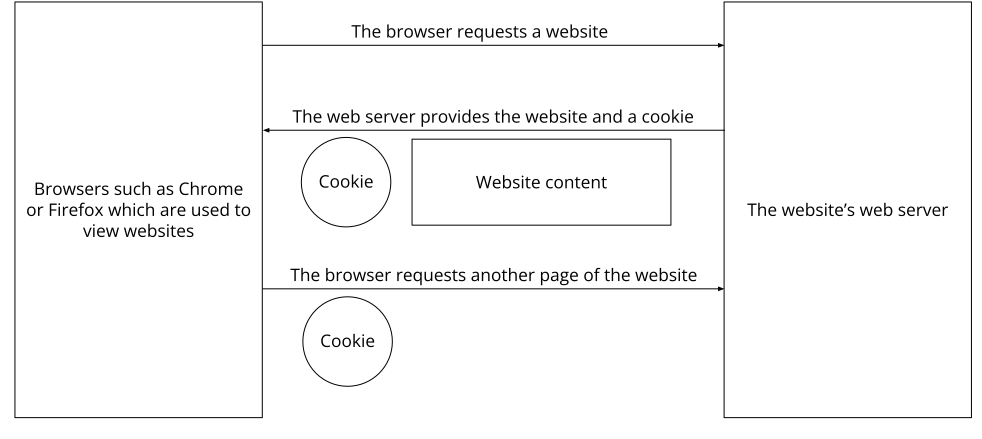
There are both first-party cookies and third-party cookies. First-party cookies are created directly by our site, while third-party cookies are created by partner-websites (e.g. Google Analytics). Each cookie must be evaluated individually, as each cookie stores different data. The expiry time of a cookie also varies from a few minutes to a few years. Cookies are not software programs and do not contain viruses, trojans or other malware. Cookies also cannot access your PC’s information.
This is an example of how cookie-files can look:
Name: _ga
Value: GA1.2.1326744211.152112786303-9
Purpose: Differentiation between website visitors
Expiry date: after 2 years
A browser should support these minimum sizes:
- At least 4096 bytes per cookie
- At least 50 cookies per domain
- At least 3000 cookies in total
Which types of cookies are there?
The exact cookies that we use, depend on the used services, which will be outlined in the following sections of this privacy policy. Firstly, we will briefly focus on the different types of HTTP-cookies.
There are 4 different types of cookies:
Essential cookies
These cookies are necessary to ensure the basic functions of a website. They are needed when a user for example puts a product into their shopping cart, then continues surfing on different websites and comes back later in order to proceed to the checkout. These cookies ensure the shopping cart does not get deleted, even if the user closes their browser window.
Purposive cookies
These cookies collect information about user behaviour and whether the user receives any error messages. Furthermore, these cookies record the website’s loading time as well as its behaviour in different browsers.
Target-orientated cookies
These cookies ensure better user-friendliness. Thus, information such as previously entered locations, fonts sizes or data in forms stay stored.
Advertising cookies
These cookies are also known as targeting cookies. They serve the purpose of delivering customised advertisements to the user. This can be very practical, but also rather annoying.
Upon your first visit to a website you are usually asked which of these cookie-types you want to accept. Furthermore, this decision will of course also be stored in a cookie.
If you want to learn more about cookies and do not mind technical documentation, we recommend https://tools.ietf.org/html/rfc6265, the Request for Comments of the Internet Engineering Task Force (IETF) called “HTTP State Management Mechanism”.
Purpose of processing via cookies
The purpose ultimately depends on the respective cookie. You can find out more details below or from the software manufacturer that sets the cookie.
Which data are processed?
Cookies are little helpers for a wide variety of tasks. Unfortunately, it is not possible to tell which data is generally stored in cookies, but in the privacy policy below we will inform you on what data is processed or stored.
Storage period of cookies
The storage period depends on the respective cookie and is further specified below. Some cookies are erased after less than an hour, while others can remain on a computer for several years.
You can also influence the storage duration yourself. You can manually erase all cookies at any time in your browser (also see “Right of objection” below). Furthermore, the latest instance cookies based on consent will be erased is after you withdraw your consent. The legality of storage will remain unaffected until then.
Right of objection – how can I erase cookies?
You can decide for yourself how and whether you want to use cookies. Regardless of which service or website the cookies originate from, you always have the option of erasing, deactivating or only partially accepting cookies. You can for example block third-party cookies but allow all other cookies.
If you want to find out which cookies have been stored in your browser, or if you want to change or erase cookie settings, you can find this option in your browser settings:
Chrome: Clear, enable and manage cookies in Chrome
Safari: Manage cookies and website data in Safari
Firefox: Clear cookies and site data in Firefox
Internet Explorer: Delete and manage cookies
Microsoft Edge: Delete cookies in Microsoft Edge
If you generally do not want cookies, you can set up your browser in a way to notify you whenever a cookie is about to be set. This gives you the opportunity to manually decide to either permit or deny the placement of every single cookie. This procedure varies depending on the browser. Therefore, it might be best for you to search for the instructions in Google. If you are using Chrome, you could for example put the search term “delete cookies Chrome” or “deactivate cookies Chrome” into Google.
Legal basis
The so-called “cookie directive” has existed since 2009. It states that the storage of cookies requires your consent (Article 6 Paragraph 1 lit. a GDPR). Within countries of the EU, however, the reactions to these guidelines still vary greatly. In Austria, however, this directive was implemented in Section 165 (3) of the Telecommunications Act (2021). In Germany, the cookie guidelines have not been implemented as national law. Instead, this guideline was largely implemented in Section 15 (3) of the Telemedia Act (TMG), which has been replaced by the Digital Services Act (DSA) since May 2024.
For absolutely necessary cookies, even if no consent has been given, there are legitimate interests (Article 6 (1) (f) GDPR), which in most cases are of an economic nature. We want to offer our visitors a pleasant user experience on our website. For this, certain cookies often are absolutely necessary.
This is exclusively done with your consent, unless absolutely necessary cookies are used. The legal basis for this is Article 6 (1) (a) of the GDPR.
In the following sections you will find more detail on the use of cookies, provided the used software does use cookies.
Application Data
| Application Data Summary 👥 Affected Parties: Users applying for a job position with us 🤝 Purpose: Processing a job application procedure 📓 Processed Data: Name, address, contact details, email address, phone number, proof of qualifications (certificates), potentially data of special categories. 📅 Retention Period: For successful applications, data will be retained until the end of the employment relationship. Otherwise, the data will be deleted after the application process or stored for a certain period with your consent. ⚖️ Legal Basis: Art. 6(1)(a) GDPR (consent), legitimate interest (Art. 6(1)(f) GDPR), Art. 6(1)(b) GDPR (contract), Art. 9(2)(a) GDPR (processing special categories of data) |
What is application data?
You can apply for a job at our company via email, online form, or a recruiting tool. All data we receive and process as part of an application is considered application data. This includes personal data such as name, date of birth, address, and phone number.
Why do we process application data?
We process your data to carry out a proper selection process for the advertised position. Additionally, we may retain your application documents in our applicant archive. Often, we are impressed by a candidate and their application but cannot proceed with collaboration for various reasons. With your consent, we archive your documents so we can easily contact you for future opportunities in our company.
We assure you that we handle your data with the utmost care and always process it within the legal framework. Within our company, your data is only shared with individuals directly involved in your application process. In short: Your data is safe with us!
What data is processed?
For example, when you apply via email, we naturally receive personal data as mentioned above. Even the email address itself is considered personal data. During the application process, only data relevant to deciding whether we would like to welcome you to our team is processed.
The specific data processed depends primarily on the job listing. However, it usually includes your name, date of birth, contact details, and proof of qualifications. If you submit your application via an online form, the data is transmitted to us in encrypted form. If you send your application via email, this encryption does not occur, and we cannot take responsibility for the transmission method. Once the data is on our servers, we are responsible for its lawful handling.
During the application process, information about your health or ethnic origin may also be requested. This helps us comply with legal obligations related to labor law, social security, and social protection. These are considered special category data.
Here is a list of possible data we receive and process:
- Name
- Contact address
- Email address
- Phone number
- Date of birth
- Information from cover letters and resumes
- Proof of qualifications (e.g., certificates)
- Special category data (e.g., ethnic origin, health data, religious beliefs)
- Usage data (visited websites, access data, etc.)
- Metadata (IP address, device information)
How long is the data stored?
If you join our team, your data will be further processed for employment purposes and retained at least until the employment relationship ends. All application documents will then become part of your employee file.
If we do not offer you the position, you decline our offer, or withdraw your application, we may retain your data for up to 6 months after the application process ends under legitimate interest (Art. 6(1)(f) GDPR). After that, both electronic data and physical documents will be fully deleted or destroyed. We retain your data, for example, to answer follow-up questions or to provide evidence of the application in case of legal disputes. If a legal dispute arises and we need the data beyond the 6-month period, we will delete it only when there is no longer any reason to retain it. If there are statutory retention obligations, we must store the data longer than 6 months.
Furthermore, we may retain your data longer if you provide explicit consent. This might be the case if we see potential for future collaboration. In such cases, your data will be included in our applicant pool. Of course, you can withdraw your consent for extended retention at any time. If no withdrawal is made and no new consent is given, your data will be deleted after a maximum of 2 years.
Legal Basis
The legal bases for processing your data are Art. 6(1)(a) GDPR (consent), Art. 6(1)(b) GDPR (contract or pre-contractual measures), Art. 6(1)(f) GDPR (legitimate interests), and Art. 9(2)(a) GDPR (processing special categories of data).
If we include you in our applicant tool, it is based on your consent (Art. 6(1)(a) GDPR). We emphasize that your consent to join our applicant pool is voluntary, does not affect the application process, and can be withdrawn at any time. The legality of processing until the point of withdrawal remains unaffected.
In cases where vital interests are at stake, data processing occurs under Art. 9(2)(c) GDPR. For purposes related to healthcare, occupational medicine, medical diagnosis, provision of health or social care, or the management of systems and services in health or social care, data is processed under Art. 9(2)(h) GDPR. If you voluntarily provide special category data, processing is based on Art. 9(2)(a) GDPR.
Customer Data
| Customer Data Overview 👥Affected parties: Customers or business and contractual partners 🤝 Purpose: Performance of a contract for the provision of agreed services or prior to entering into such a contract, including associated communications. 📓 Data processed: name, address, contact details, email address, telephone number, payment information (such as invoices and bank details), contract data (such as duration and subject matter of the contract), IP address, order data 📅 Storage period: the data will be erased as soon as they are no longer required for our business purposes and there is no legal obligation to process them. ⚖️ Legal bases: Legitimate interests (Art. 6 Para. 1 lit. f GDPR), Contract (Art. 6 Para. 1 lit. b GDPR) |
What is customer data?
In order to be able to offer our services and contractual services, we also process data from our customers and business partners. This data always includes personal data. Customer data is all information that is processed on the basis of contractual or pre-contractual agreements so that the offered services can be provided. Customer data is therefore all the information we collect and process about our customers.
Why do we process customer data?
There are many reasons why we collect and process customer data. The main reason is that we simply need specific data to provide our services. Sometimes for example your email address may be enough. But if you purchase a product or service, we may e. g. also need data such as your name, address, bank details or other contract data. This data will subsequently be used for marketing and sales optimisation so that we can improve our overall service for our customers and clients. Another important reason for data processing is our customer service, which is very important to us. We want you to have the opportunity to contact us at any time with questions about our offers. Thus, we may need certain data such as your email address at the very least.
What data is processed?
Exactly which data is stored can only be shown by putting them in categories. All in all, it always depends on which of our services you receive. In some cases, you may only give us your email address so that we can e. g. contact you or answer your questions. In other instances, you may purchase one of our products or services. Then we may need significantly more information, such as your contact details, payment details and contract details.
Here is a list of potential data we may receive and process:
- Name
- Contact address
- Email address
- Phone number
- Your birthday
- Payment data (invoices, bank details, payment history, etc.)
- Contract data (duration, contents)
- Usage data (websites visited, access data, etc.)
- Metadata (IP address, device information)
How long is the data stored?
We erase corresponding customer data as soon as we no longer need it to fulfill our contractual obligations and purposes, and as soon as the data is also no longer necessary for possible warranty and liability obligations. This can for example be the case when a business contract ends. Thereafter, the limitation period is usually 3 years, although longer periods may be possible in individual cases. Of course, we also comply with the statutory retention requirements. Your customer data will certainly not be passed on to third parties unless you have given your explicit consent.
Legal Basis
The legal basis for the processing of your data is Article 6 Paragraph 1 Letter a GDPR (consent), Article 6 Paragraph 1 Letter b GDPR (contract or pre-contractual measures), Article 6 Paragraph 1 Letter f GDPR (legitimate interests) and in special cases (e. g. medical services) Art. 9 (2) lit. GDPR (processing of special categories).
In the case of protecting vital interests, data processing is carried out in accordance with Article 9 Paragraph 2 Letter c. GDPR. For the purposes of health care, occupational medicine, medical diagnostics, care or treatment in the health or social sectors or for the administration of systems and services in health or social sectors, the processing of personal data takes place in accordance with Art. 9 Para. 2 lit. h. GDPR. If you voluntarily provide data of these special categories, the processing takes place on the basis of Article 9 Paragraph 2 lit. a GDPR.
Web hosting
| Web hosting Overview 👥 Affected parties: visitors to the website 📓 Purpose: professional hosting of the website and security of operations 🤝 Processed data: IP address, time of website visit, browser used and other data. You can find more details on this below or at the respective web hosting provider. 📅 Storage period: dependent on the respective provider, but usually 2 weeks ⚖️ Legal basis: Art. 6 para. 1 lit. f GDPR (legitimate interests) |
What is web hosting?
Every time you visit a website nowadays, certain information – including personal data – is automatically created and stored, including on this website. This data should be processed as sparingly as possible, and only with good reason. By website, we mean the entirety of all websites on your domain, i.e. everything from the homepage to the very last subpage (like this one here). By domain we mean example.uk or examplepage.com.
When you want to view a website on a screen, you use a program called a web browser. You probably know the names of some web browsers: Google Chrome, Microsoft Edge, Mozilla Firefox, and Apple Safari.
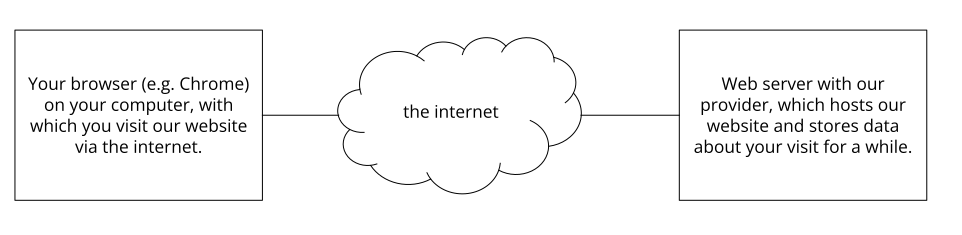
The web browser has to connect to another computer which stores the website’s code: the web server. Operating a web server is complicated and time-consuming, which is why this is usually done by professional providers. They offer web hosting and thus ensure the reliable and flawless storage of website data.
Whenever the browser on your computer establishes a connection (desktop, laptop, smartphone) and whenever data is being transferred to and from the web server, personal data may be processed. After all, your computer stores data, and the web server also has to retain the data for a period of time in order to ensure it can operate properly.
Illustration:
Why do we process personal data?
The purposes of data processing are:
- Professional hosting of the website and operational security
- To maintain the operational as well as IT security
- Anonymous evaluation of access patterns to improve our offer, and if necessary, for prosecution or the pursuit of claims.li>
Which data are processed?
Even while you are visiting our website, our web server, that is the computer on which this website is saved, usually automatically saves data such as
- the full address (URL) of the accessed website (e. g. https://www.examplepage.uk/examplesubpage.html?tid=112786303)
- browser and browser version (e.g. Chrome 87)
- the operating system used (e.g. Windows 10)
- the address (URL) of the previously visited page (referrer URL) (e. g. https://www.examplepage.uk/icamefromhere.html/)
- the host name and the IP address of the device from the website is being accessed from (e.g. COMPUTERNAME and 194.23.43.121)
- date and time
- in so-called web server log files
How long is the data stored?
Generally, the data mentioned above are stored for two weeks and are then automatically deleted. We do not pass these data on to others, but we cannot rule out the possibility that this data may be viewed by the authorities in the event of illegal conduct.
In short: Your visit is logged by our provider (company that runs our website on special computers (servers)), but we do not pass on your data without your consent!
Legal basis
The lawfulness of processing personal data in the context of web hosting is justified in Art. 6 para. 1 lit. f GDPR (safeguarding of legitimate interests), as the use of professional hosting with a provider is necessary to present the company in a safe and user-friendly manner on the internet, as well as to have the ability to track any attacks and claims, if necessary.
GitHub Pages Privacy Policy
We use the web hosting service GitHub Pages for our website. The provider of this service is the American company GitHub Inc., 88 Colin P. Kelly Jr. St., San Francisco, CA 94107, USA.
GitHub also processes data in the USA, among other countries. We would like to note, that according to the European Court of Justice, there is currently no adequate level of protection for data transfers to the USA. This can be associated with various risks to the legality and security of data processing.
GitHub uses standard contractual clauses approved by the EU Commission as the basis for data processing by recipients based in third countries (i. e. outside the European Union, Iceland, Liechtenstein, Norway, and thus especially in the USA) or data transfer there (= Art. 46, paragraphs 2 and 3 of the GDPR). Standard Contractual Clauses (SCC) are legal templates provided by the EU Commission. Their purpose is to ensure that your data complies with European data privacy standards, even if your data is transferred to and stored in third countries (such as the USA). With these clauses, GitHub commits to comply with the EU‘s level of data protection when processing relevant data, even if it is stored, processed and managed in the USA. These clauses are based on an implementing order by the EU Commission. You can find the order and the standard contractual clauses here: https://ec.europa.eu/commission/presscorner/detail/en/ip_21_2847.
You can find GitHub’s Data Processing Agreement, which corresponds to the Standard Contractual Clauses, at https://docs.github.com/en/site-policy/privacy-policies/github-data-protection-agreement.
You can find out more about the data that is processed by using GitHub in their Privacy Policy at https://docs.github.com/en/site-policy/privacy-policies/github-privacy-statement.
Web Analytics
| Web Analytics Privacy Policy Overview 👥 Affected parties: visitors to the website 🤝 Purpose: Evaluation of visitor information to optimise the website. 📓 Processed data: Access statistics that contain data such as access location, device data, access duration and time, navigation behaviour, click behaviour and IP addresses. You can find more details on this from the respective web analytics tool directly. 📅 Storage period: depending on the respective web analytics tool used ⚖️ Legal basis: Art. 6 para. 1 lit. a GDPR (consent), Art. 6 para. 1 lit. f GDPR (legitimate interests) |
What is Web Analytics?
We use software on our website, which is known as web analytics, in order to evaluate website visitor behaviour. Thus, data is collected, which the analytic tool provider (also called tracking tool) stores, manages and processes. Analyses of user behaviour on our website are created with this data, which we as the website operator receive. Most tools also offer various testing options. These enable us, to for example test which offers or content our visitors prefer. For this, we may show you two different offers for a limited period of time. After the test (a so-called A/B test) we know which product or content our website visitors find more interesting. For such testing as well as for various other analyses, user profiles are created and the respective data is stored in cookies.
Why do we run Web Analytics?
We have a clear goal in mind when it comes to our website: we want to offer our industry’s best website on the market. Therefore, we want to give you both, the best and most interesting offer as well as comfort when you visit our website. With web analysis tools, we can observe the behaviour of our website visitors, and then improve our website accordingly for you and for us. For example, we can see the average age of our visitors, where they come from, the times our website gets visited the most, and which content or products are particularly popular. All this information helps us to optimise our website and adapt it to your needs, interests and wishes.
Which data are processed?
The exact data that is stored depends on the analysis tools that are being used. But generally, data such as the content you view on our website are stored, as well as e. g. which buttons or links you click, when you open a page, which browser you use, which device (PC, tablet, smartphone, etc.) you visit the website with, or which computer system you use. If you have agreed that location data may also be collected, this data may also be processed by the provider of the web analysis tool.
Moreover, your IP address is also stored. According to the General Data Protection Regulation (GDPR), IP addresses are personal data. However, your IP address is usually stored in a pseudonymised form (i.e. in an unrecognisable and abbreviated form). No directly linkable data such as your name, age, address or email address are stored for testing purposes, web analyses and web optimisations. If this data is collected, it is retained in a pseudonymised form. Therefore, it cannot be used to identify you as a person.
The following example shows Google Analytics’ functionality as an example for client-based web tracking with JavaScript code.
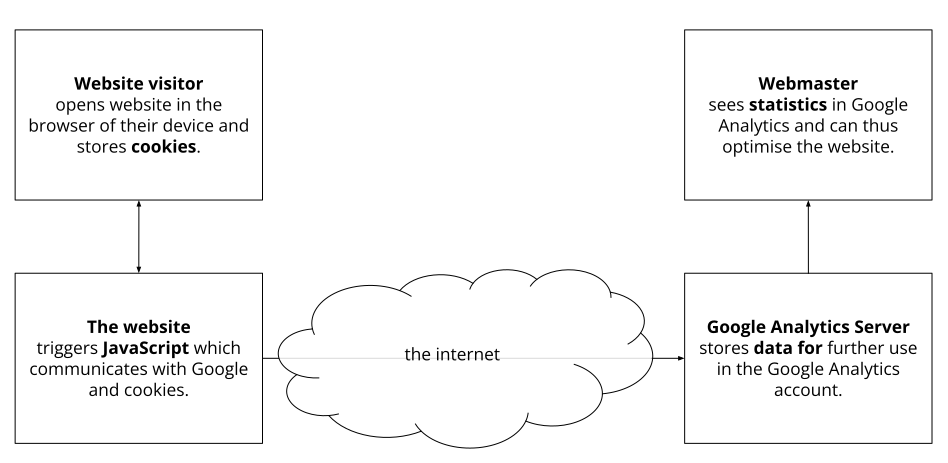
The storage period of the respective data always depends on the provider. Some cookies only retain data for a few minutes or until you leave the website, while other cookies can store data for several years.
Duration of data processing
If we have any further information on the duration of data processing, you will find it below. We generally only process personal data for as long as is absolutely necessary to provide products and services. The storage period may be extended if it is required by law, such as for accounting purposes for example for accounting.
Right to object
You also have the option and the right to revoke your consent to the use of cookies or third-party providers at any time. This works either via our cookie management tool or via other opt-out functions. For example, you can also prevent data processing by cookies by managing, deactivating or erasing cookies in your browser.
Legal basis
The use of Web Analytics requires your consent, which we obtained with our cookie popup. According to Art. 6 para. 1 lit. a of the GDPR (consent), this consent represents the legal basis for the processing of personal data, such as by collection through Web Analytics tools.
In addition to consent, we have a legitimate interest in analysing the behaviour of website visitors, which enables us to technically and economically improve our offer. With Web Analytics, we can recognise website errors, identify attacks and improve profitability. The legal basis for this is Art. 6 para. 1 lit. f of the GDPR (legitimate interests). Nevertheless, we only use these tools if you have given your consent.
Since Web Analytics tools use cookies, we recommend you to read our privacy policy on cookies. If you want to find out which of your data are stored and processed, you should read the privacy policies of the respective tools.
If available, information on special Web Analytics tools can be found in the following sections.
Online Map Services Introduction
| Online Map Services Privacy Policy Overview 👥 Affected parties: website visitors 🤝 Purpose: Improvement of user experience 📓 Processed data: the data that is processed depends heavily on the services used. Usually, it is your IP address, location data, search queries and/or technical data. You can find more details on this under the respective tools used. 📅 Storage duration: depends on the tools used ⚖️ Legal bases: Article 6 paragraph 1 lit. a GDPR (consent), Article 6 paragraph 1 lit. f GDPR (legitimate interests) |
What are Online Map Services?
We also use online map services for our website as an extended service. Google Maps is probably the service you are most familiar with. But there are also other providers out there that specialise in creating digital maps. These services allow the display of locations, route maps or other geographical information directly via our website. Thanks to an integrated map service, you no longer have to leave our website to e. g. view the route to a location. In order to ensure that the online map can run on our website, we have integrated map sections within our HTML code. This way the services can display street maps, the earth’s surface, or aerial or satellite imagery. If you use the built-in map service, your data will be transferred to the tool used, where it will be retained. This may also include your personal data.
Why do we use Online Map Services on our website?
Generally speaking, it is imperative for us to offer you a pleasant time on our website. Of course, we know that you will most likely only enjoy your time here if you can easily find your way around and find all the information you need quickly and easily. Therefore, we decided that an online map system may be a significant optimisation of our website’s service. After all, you can use the map system to easily view route descriptions, locations or any other points of interest – without leaving our site. Needless to say, it is certainly also very practical that you can easily see where our company headquarters are so that you can find us quickly and safely. As you can see, there are just a lot of advantages – and we clearly consider online map services on our website to be part of our customer service.
What data is stored by Online Map Services?
If you open a page on our website with an online map function installed, your personal data may be transmitted to the relevant service, where it may be stored. This usually includes your IP address, which may also be used to determine your approximate location. In addition to your IP address, data such as the search terms you entered, as well as your longitude and latitude coordinates will be stored. If you e. g. enter an address for route planning, this data will also be stored. This data is not stored by us but instead on the servers of the integrated tools. You can think of it like this: You may be on our website, but when you interact with a mapping service, that interaction is actually happening on their website. Moreover, in order for the service to function properly, at least one cookie is usually set in your browser. As an example, Google Maps also uses cookies to record user behaviour, with which it can optimise its own service and offer personalised advertising. You can find out more about cookies in our “Cookies” section.
How long and where is the data stored?
Every online map service processes different user data. Provided we have further information, we will inform you about the duration of data processing in the corresponding sections on the individual tools below. Generally, personal data is only retained for as long as is necessary to provide the service. Google Maps e. g. stores certain data for a specified period of time, but you must erase other data yourself. At Mapbox, for example, your IP address is stored for 30 days after which it is deleted. As you can see, each tool stores data for different lengths of time. We thus recommend you take a closer look at the privacy policies of the tools used.
The providers may use cookies to store data on your user behaviour in relation to their map services. You can find more information about cookies in our “Cookies” section, but in the individual providers’ privacy policies you can most probably also find out which cookies may be used. In most cases, however, this is only an indicative list and is not exhaustive.
Right to object
You always have the possibility and the right to access your personal data and to object to its use and processing. You can also revoke the consent you gave to us at any time. This is usually easiest through the cookie consent tool. However, there are other opt-out tools that you can use. You can also manage, erase or deactivate any cookies set by the used providers yourself with just a few mouse clicks. However, this may lead to some service functions stopping to work as usual. It also depends on your browser how you can manage cookies there. In our “Cookies” section you will find links to instructions of the most popular browsers.
Legal Basis
If you have agreed to the use of an online map service, the legal basis for the corresponding data processing is this consent. According to Article 6 Paragraph 1 lit. (consent) this consent is the legal basis for the processing of personal data as may occur when collected by an online map service.
We also have a legitimate interest in using an online map service to optimise our service on our website. The corresponding legal basis for this is Article 6 (1) (f) GDPR (legitimate interests). However, we only use an online map service if you have given your consent. We definitely wanted to stress this point once again.
You can find information on specific online map services – if available – in the following sections.
Google Maps Privacy Policy
| Google Maps Privacy Policy Overview 👥 Affected parties: website visitors 🤝 Purpose: service optimisation 📓 Processed data: data such as entered search terms, IP address as well as latitude and longitude coordinates. You can find more details on this in the Privacy Policy below. 📅 Storage duration: depending on the retained data ⚖️ Legal bases: Art. 6 para. 1 lit. a GDPR (consent), Art. 6 para. 1 lit. f GDPR (legitimate interests) |
What is Google Maps?
On our website we use Google Maps of the company Google Inc. (1600 Amphitheatre Parkway Mountain View, CA 94043, USA). With the use of Google Maps, we can show you locations in a better way and can therefore adjust our service to your needs. Due to the utilisation of Google Maps, data gets transferred to Google and is saved on Google’s servers. In the following, we want to explain in detail what Google Maps is, why we use this Google service, what data is stored and how you can prevent this.
Google Maps is an internet maps service of the company Google Inc. With Google Maps you can search for exact locations of cities, sights, accommodations or businesses online via a PC, a tablet or an app. If businesses are represented on Google My Business, the respective location as well as other information about the company are shown there. In order to show route directions, a location’s map sections can be integrated in a website through a HTML-code. Google Maps depicts the earth’s surface as either a road map or as air and satellite images. Due to the street view and high-quality satellite images, it is possible for exact representations to be made.
Why do we use Google Maps on our website?
The efforts we make on this page have the goal of giving you a useful and meaningful experience on our website. Through the integration of Google Maps, we can offer you essential information on various locations. Therefore, you can spot our office address with one glance. Furthermore, the route directions always show you the best and fastest way to us. You can retrieve the route directions for traveling either by car, by public transport, on foot or by bike. The integration of Google Maps is a part of our customer service.
What data is stored by Google Maps?
For Google Maps to offer its full services, the company must collect and store your data. This includes your entered search terms, your IP-address as well as your longitude and latitude coordinates. When you use the route-planner function, the entered start address is stored also. However, this data retention happens on Google Maps‘ websites. We can only inform you about it but cannot influence it in any way. Since we have included Google Maps on our website, Google will set at least one cookie (Name: NID) into your browser. This cookie saves data on your user behaviour. Google primarily uses this data to optimise ist own services and to provide you with individual, personalised advertisements.
The following cookies are set in your browser due to the integration of Google Maps:
Name: NID
Value: 188=h26c1Ktha7fCQTx8rXgLyATyITJ112786303-5
Purpose: Google uses NID in order to adjust advertisments to your Google searches. With the cookie’s help Google “remembers“ your most frequently entered search queries or your previous interaction with ads. That way you always receive customised adertisments. The cookie contains a unique ID, wich Google uses to collect your personal settings for advertising porposes.
Expiration date: after 6 months
Note: We cannot guarantee completeness of the information on saved data. This is, because especially concerning the use of cookies, changes can happen anytime. To identify the cookie NID, a test page was created, to which Google Maps was included.
How long and where is the data stored?
There are Google servers in data centres across the entire planet. However, most servers are in America. For this reason, your data is widely stored in the USA. Here you can read in detail about where the Google servers are located: https://datacenters.google/
Google distributes data to various data carriers. This makes it possible to retrieve the data faster and to better protect it from possible attempted manipulations. Every server has emergency programs. Thus, should for example a problem with Google’s hardware occur or should a natural disaster impact the servers, any data will quite certainly stay protected.
Moreover, Google saves some data for a specified period. With some other data on the other hand, Google only offers the opportunity for deleting it manually. Furthermore, the company anonymises information (e.g. advertising data) in server logs, by deleting a part of the IP-address and cookie information after 9 to 18 months.
How can I erase my data, or prevent data retention?
Due to the automatic delete function for location and activity data, which was introduced in 2019, information that is used for determining your location and web or app activity is saved for either 3 or 18 months, depending on your preferred decision, and is deleted thereafter. Furthermore, it is possible to delete this data manually from your browser history via your Google account anytime. If you want to prevent the determination of your location altogether, you must pause the category “Web and app activity” in your Google account. Click on “Data and personalisation” and then choose the option “Activity controls”. Here you can switch the activities on or off.
Moreover, in your browser you can deactivate, delete or manage individual cookies. This function can differ a little, depending on what browser you are using. The following instructions will show you how to manage cookies in your browser:
Chrome: Clear, enable and manage cookies in Chrome
Safari: Manage cookies and website data in Safari
Firefox: Clear cookies and site data in Firefox
Internet Explorer: Delete and manage cookies
Microsoft Edge: Delete cookies in Microsoft Edge
If you generally do not want to permit any cookies, you can set up your browser in a way that ensures you get informed whenever a cookie is about to be placed. That way you can decide to either permit or refuse every single cookie.
Please note, that when using this tool, your data may also be stored and processed outside the EU. Most third countries (including the USA) are not considered secure under current European data protection law. Data to insecure third countries must not simply be transferred to, stored and processed there unless there are suitable guarantees (such as EU Standard Contractual Clauses) between us and the non-European service provider.
Legal basis
If you have consented to the use of Google Maps, your consent is the legal basis for the corresponding data processing. According to Art. 6 paragraph 1 lit. a GDPR (consent) this consent is the legal basis for the processing of personal data, as can occur when processed by Google Maps.
We also have a legitimate interest in using Google Maps to optimise our online service. The corresponding legal basis for this is Art. 6 para. 1 lit. f GDPR (legitimate interests). Nevertheless, we only use Google Maps if you have given your consent to it.
Google processes data from you, among other things, in the USA. Google is an active participant in the EU-US Data Privacy Framework, which regulates the correct and secure transfer of personal data from EU citizens to the USA. More information can be found at https://commission.europa.eu/document/fa09cbad-dd7d-4684-ae60-be03fcb0fddf_en.
Additionally, Google uses so-called Standard Contractual Clauses (Article 46(2) and (3) GDPR). Standard Contractual Clauses (SCC) are template clauses provided by the EU Commission and are designed to ensure that your data complies with European data protection standards, even when transferred and stored in third countries (such as the USA). Through the EU-US Data Privacy Framework and the Standard Contractual Clauses, Google commits to maintaining the European data protection level when processing your relevant data, even if the data is stored, processed, and managed in the USA. These clauses are based on an implementing decision of the EU Commission. You can find the decision and the corresponding Standard Contractual Clauses here: https://ec.europa.eu/commission/presscorner/detail/en/ip_21_2847.
The Google Ads Data Processing Terms, which reference the standard contractual clauses, can be found at https://business.safety.google/intl/en/adsprocessorterms/.
If you want to find out more about Google’s data processing, we recommend you to read the company’s own Privacy Policy at https://policies.google.com/privacy?hl=en-GB.
Online Booking Systems Introduction
| Online Booking Systems Privacy Policy Overview 👥 Affected parties: website visitors 🤝 Purpose: improvement of user experience and organisation 📓 Processed data: depends heavily on the services used. Usually, data such as IP address, contact and payment details and/or technical data is processed. You can get more details on this directly from the respective tools used. 📅 Storage duration: depends on the tools used ⚖️ Legal bases: Article 6 paragraph 1 lit. a GDPR (consent), Article 6 paragraph 1 lit. f GDPR (legitimate interests) |
What is an online booking system?
We use one or more booking systems which enable you to make bookings via our website. That way e.g. appointments can easily be created online. A booking system is a software application integrated into our website that displays available resources (such as available appointments) and allows you to book – and usually, also pay – directly online. You’ve probably already come across many such booking systems from the restaurant or hotel industry. However, such systems are actually used in a wide variety of industries. Depending on the tool and settings, booking systems can be used both by us internally, as well as by customers like yourself. In most cases, your personal data is also collected and stored.
Bookings usually work as follows: You will find a booking system on our website, through which you can book an appointment directly with one click. Then you will enter your data and usually also be able to pay immediately. You may also have the option to enter various information about yourself into a form. Please be aware that any information you enter may be stored and managed in a database.
Why do we use an online booking system?
In a way, we also consider our website a free service for you. We want you to receive helpful information on our site and feel comfortable on there. This also includes an online service that makes it as easy as possible for you to book appointments or services. Gone are the days when you had to wait days for booking confirmations via phone or email. With an online booking system, you can get everything done after just a few clicks and get on with your day. The system also makes it easier for us to manage all bookings and appointments. Therefore, we consider a booking system absolutely sensible for both you and ourselves.
Which data is processed?
In this general introduction about booking systems, we naturally cannot tell you exactly what data is processed for which system. It always depends on the tool used, as well as the functions and possibilities it contains. What is more, in addition to the conventional booking function, many booking systems also offer a range of other features. For example, many systems also have an external online payment system (e.g. Stripe, Klarna or Paypal) and an integrated calendar synchronisation function. Accordingly, different data and different amounts of data can be processed, depending on the included functions. Usually, data such as your IP address, name and contact details, technical device information and the time of your booking are processed. If you also make a payment via the system, your bank details such as your account number, credit card number, passwords, TANs etc. will also be stored and passed on to the respective payment provider. We recommend you carefully read the respective privacy policy of the tool used, so that you know which of your data is processed specifically.
Duration of data processing
Each booking system stores data for different lengths of time. Therefore, we cannot yet give any specific information about the duration of data processing in this instance. In general, however, personal data is only stored for as long as is absolutely necessary to provide the services. Booking systems usually also use cookies, which store information for different lengths of time. While some cookies are erased immediately after leaving the site, others can be stored for a number of years. You can find out more about this in our “Cookies” section. Please also take a look at the respective privacy policies of the providers. There you should find answers on how long your data will be stored specifically.
Right to object
If you have consented to data processing by a booking system, you always retain the option and the right to revoke this consent. So please, always be aware that you have rights in relation to your personal data and that you can exercise these rights at any time. Thus, if you do not agree to the processing of your personal data, then none of your personal data may be processed. It is that simple. The easiest way to revoke data processing is via a cookie consent tool or via other available opt-out functions. You can, for example, manage data retention by cookies directly in your browser. Until you withdraw your consent, the lawfulness of data processing remains unaffected.
Legal Basis
If you have agreed that booking systems may be used, this consent is the legal basis for the corresponding data processing. According to Article 6 (1) (a) GDPR (consent), your consent represents the legal basis for the processing of personal data, as it may occur through the use of booking systems.
Furthermore, we also have a legitimate interest in using booking systems because we use them to extend our customer service and to optimise our internal booking organisation. The corresponding legal basis for this is Article 6 (1) (f) GDPR (legitimate interests). However, we strongly want to emphasise once more that we only use these tools if you have given your consent.
You can find information on different booking systems – if available – in the following sections.
Calendly Privacy Policy
We also use the online booking system Calendly. The provider of this service is the American company Calendly Inc., 115 E Main Str., Ste A1B, Buford, GA 30518, USA.
Calendly processes data from you, among other things, in the USA. Calendly is an active participant in the EU-US Data Privacy Framework, which regulates the correct and secure transfer of personal data from EU citizens to the USA. More information can be found at https://commission.europa.eu/document/fa09cbad-dd7d-4684-ae60-be03fcb0fddf_en.
Additionally, Calendly uses so-called Standard Contractual Clauses (Article 46(2) and (3) GDPR). Standard Contractual Clauses (SCC) are template clauses provided by the EU Commission and are designed to ensure that your data complies with European data protection standards, even when transferred and stored in third countries (such as the USA). Through the EU-US Data Privacy Framework and the Standard Contractual Clauses, Calendly commits to maintaining the European data protection level when processing your relevant data, even if the data is stored, processed, and managed in the USA. These clauses are based on an implementing decision of the EU Commission. You can find the decision and the corresponding Standard Contractual Clauses here: https://ec.europa.eu/commission/presscorner/detail/en/ip_21_2847.
You can find more information about the standard contractual clauses at Calendly in the data processing terms at https://calendly.com/dpa.
You can find out more about the data that is processed by Calendly in their Privacy Policy at https://calendly.com/privacy.
Data Processing Agreement (DPA) Calendly
In accordance with Article 28 of the General Data Protection Regulation (GDPR), we have entered into a Data Processing Agreement (DPA) with Calendly. What exactly a DPA is and especially what must be included in a DPA, you can read in our general section “Data Processing Agreement (DPA)”.
This contract is required by law because Calendly processes personal data on our behalf. It clarifies that Calendly may only process data they receive from us according to our instructions and must comply with the GDPR. You can find the link to the Data Processing Agreement (DPA) under https://calendly.com/dpa.
Explanation of the terminology used
We always strive to make our privacy policy as clear and comprehensible as possible. However, this is not always easy, especially when it comes to technical and legal matters. It is often sensible to use legal terms (such as ‘personal data)’ or certain technical terms (such as ‘cookies’ or ‘IP address’). But we don’t want to use such terms without any explanation. This is why you will find an alphabetical list of important terms used below. These are terms we may not yet have sufficiently explained in the privacy policy. In case we have adopted any of these terms from the GDPR which are definitions, we will also list the GDPR texts here and add our own further explanations if necessary.
Processor
Definition according to Article 4 of the GDPR
For the purposes of this Regulation, the term means:
“processor” means a natural or legal person, public authority, agency or other body which processes personal data on behalf of the controller;
Explanation: As a company and a website owner, we are responsible for all your data we process (i. e. the ‘controller’). In addition to the controller, there may also be so-called processors. This includes any company or person who processes personal data on our behalf. In addition to service providers such as tax consultants, processors can also be hosting or cloud providers, payment or newsletter providers or large companies such as Google or Microsoft.
Consent
Definition according to Article 4 of the GDPR
For the purposes of this Regulation, the term means:
“consent” of the data subject means any freely given, specific, informed and unambiguous indication of the data subject’s wishes by which he or she, by a statement or by a clear affirmative action, signifies agreement to the processing of personal data relating to him or her;
Explanation: With websites, such consent is usually given via a cookie consent tool. You’ve most certainly come across these. Whenever you visit a website for the first time, you will usually be asked via a banner whether you agree or consent to the data processing. You can usually also make individual settings and thus decide for yourself which level of data processing you want to allow. If you do not give your consent, no personal data may be processed. Consent can of course also be given in writing, i.e. not via a tool.
Data concerning health
Definition according to Article 4 of the GDPR
For the purposes of this Regulation, the term means:
“Data concerning health” means personal data related to the physical or mental health of a natural person, including the provision of health care services, which reveal information about his or her health status;
Explanation: Health data includes all stored information relating to your own health. It is often data that is also noted in patient files. This includes, for example, which medication you are using, X-rays, your entire medical history or your vaccination statuses.
Personal Data
Definition according to Article 4 of the GDPR
For the purposes of this Regulation, the term means:
“personenal data” means any information relating to an identified or identifiable natural person (‘data subject’); an identifiable natural person is one who can be identified, directly or indirectly, in particular by reference to an identifier such as a name, an identification number, location data, an online identifier or to one or more factors specific to the physical, physiological, genetic, mental, economic, cultural or social identity of that natural person;
Explanation: Personal data is all data that can identify you as a person. This is usually data such as:
- name
- address
- email address
- postal address
- phone number
- birthday
- identification numbers such as social security number, tax identification number, ID card number or matriculation number
- banking data such as account number, credit information, account balances and more.
According to the European Court of Justice (ECJ), your IP address is also personal data. IT experts can use your IP address to determine at least the approximate location of your device and subsequently your location as the connection owner. Therefore, storing an IP address also requires a legal basis within the scope of the GDPR. There are also so-called “special categories” of personal data, which are particularly worthy of protection. These include:
- racial and ethnic origin
- political opinions
- religious or ideological beliefs
- Union membership
- genetic data such as data obtained from blood or saliva samples
- biometric data (this is information about psychological, physical or behavioural characteristics that can identify an individual).
health Data - Data relating to sexual orientation or sex life
Profiling
Definition according to Article 4 of the GDPR
For the purposes of this Regulation, the term means:
“Profiling” means any form of automated processing of personal data consisting of the use of personal data to evaluate certain personal aspects relating to a natural person, in particular to analyse or predict aspects concerning that natural person’s performance at work, economic situation, health, personal preferences, interests, reliability, behaviour, location or movements;
Explanation: Profiling collects various personal data about an individual in order to learn more about that individual. On the internet, profiling is often used for advertising purposes or for credit checks. Web and advertising analysis programs e. g. collect data about your behaviour and interests on a website. This results in a special user profile that can be used to target advertising to specific target groups.
Controller
Definition according to Article 4 of the GDPR
For the purposes of this Regulation, the term means:
“controller” means the natural or legal person, public authority, agency or other body which, alone or jointly with others, determines the purposes and means of the processing of personal data; where the purposes and means of such processing are determined by Union or Member State law, the controller or the specific criteria for its nomination may be provided for by Union or Member State law;
Explanation: In our example, we are responsible for the processing of your personal data and are therefore the “controller”. If we pass on collected data to other service providers for processing, they are considered “contract processors”. For this, a “Data Processing Agreement (DPA)” must be concluded.
Processing
Definition according to Article 4 of the GDPR
For the purposes of this Regulation, the term means:
“processing” means any operation or set of operations which is performed on personal data or on sets of personal data, whether or not by automated means, such as collection, recording, organisation, structuring, storage, adaptation or alteration, retrieval, consultation, use, disclosure by transmission, dissemination or otherwise making available, alignment or combination, restriction, erasure or destruction;
Note: When we talk about processing in our Privacy Policy, we talk about any type of data processing. As mentioned above in the original GDPR declaration, this includes not only the collection but also the storage and processing of data.
Closing Remarks
Congratulations! If you are reading these lines, you have most likely familiarised yourself with our entire Privacy Policy – or at least scrolled down here. As you can see from the scope of our Privacy Policy, we do not take the protection of your personal data lightly.
We find it important to inform you about the processing of your personal data to the best of our abilities. In doing so, we not only want to tell you which data is processed but also explain to you why we use various software programs. In general, Privacy Policies have very technical and legal jargon. However, since most of you are not web developers or solicitors, we wanted to take a different approach and explain the facts in simple and clear language. Of course, this is not always possible due to the subject matter. Therefore, you can also find a more detailed explanation of the most important terms at the end of the Privacy Policy.
If you have any questions about data protection on our website, please do not hesitate to contact us or the responsible body. We wish you all the best and hope to soon welcome you to our website again.
All texts are copyrighted.